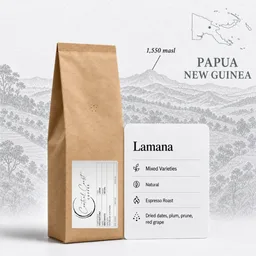
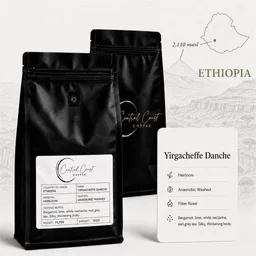
Driftwood Blend
From Central Coast Coffee in Somersby, NSW
Tasting notes
Jammy Apricot · Brown Sugar · Dried Apple · Dark Chocolate
- Origin
- Roast
- Medium · For espresso
- Process
- Washed
- Caffeine
- Regular
- Varietals
- Heirloom, Caturra, Catuai, Catimor
- Certifications
- Organic
What Central Coast Coffee say
This coffee’s roasted in our espresso style — but that doesn’t mean you need to brew it as espresso. You can make it however you like — espresso, filter, moka pot, AeroPress or whatever you enjoy. We roast it a touch darker than we would a filter roast to caramelise the sugars and bring out smooth chocolatey and nutty flavours that cut beautifully through milk.
When you add milk the natural sweetness, fat and proteins tend to soften acidity and highlight caramelised flavours. That’s why lighter filter roasts can sometimes taste a bit sharp or sour with milk — they’re simply not built for it. Espresso roasts being more developed balance this out. The deeper caramelisation creates toffee and cocoa notes that blend harmoniously with milk’s creaminess while a hint of gentle bitterness adds that satisfying ‘coffee punch’ in your flat white or cappuccino.
If you prefer your coffee black this roast will still give you a full-bodied rich cup with plenty of depth and sweetness. For a lighter fruitier experience you might enjoy exploring our filter range instead.
“Heirloom” is a catch-all term for the countless wild or cultivated varieties found in Ethiopia, many of which are genetically unique. These coffees are renowned for their complexity, often showcasing vibrant florals, citrus, and stone fruits. Since they’re genetically diverse and often uncatalogued, each heirloom coffee is a unique experience.
Caturra is a dwarf mutation of Bourbon discovered in Brazil in the early 20th century. Its compact size allows for higher planting density and easier harvesting, making it a farmer-friendly choice. It retains much of Bourbon’s flavor characteristics but can be slightly less complex. It is commonly grown in Colombia and Central America.
Catuai is a hybrid between Mundo Novo and Caturra developed in Brazil. It inherits Caturra’s compact growth and Mundo Novo’s hardiness, resulting in a high-yield, manageable plant. Flavor-wise, it is clean and balanced, though not as distinctive as Typica or Bourbon. It’s a workhorse varietal widely grown in Brazil and Latin America.
Catimor is a hybrid coffee varietal developed in Portugal in 1959 by crossing Caturra (a dwarf Bourbon mutation) with the disease-resistant Timor Hybrid, which contains Coffea canephora (Robusta) genetics. It was introduced to Southeast Asia in the 1970s to boost yields and combat coffee leaf rust. Catimor is highly productive, compact, and resistant to disease, making it appealing to smallholder farmers. Though early versions were criticized for inferior cup quality due to their Robusta lineage, modern cultivars grown at high elevations and processed with care can produce surprisingly clean, sweet, and structured cups with notes of cocoa, spice, and mild fruit.
In the washed process, coffee cherries are depulped to remove the skin and pulp, then fermented to eliminate the mucilage before thorough washing. This method produces a clean, bright cup with pronounced acidity and clarity, highlighting the coffee’s intrinsic flavors. It’s widely used in regions with ample water resources, such as Colombia and East Africa.
This green coffee is stored at 23°C in a climate-controlled room, which is a step up from standard warehouse storage, as the ambient temperature does not fluctuate as much
The ROEST P3000 is a compact powerhouse that redefines what’s possible in small-batch production roasting. With the ability to roast 1–3 kg batches in under 7 minutes and crank out over 25 kg per hour, it delivers serious output without demanding a full-time operator. Automation handles everything from preheating to cooldown, with between-batch protocols ensuring consistent conditions roast after roast. Its slim footprint and lightweight build make it perfect for roasteries where space is tight but precision and efficiency are non-negotiable.
What truly sets the P3000 apart is its unmatched control and data richness. It features more than 18 sensors—bean, exhaust, drum, humidity, pressure, and even a first-crack microphone—paired with PID-controlled airflow, drum speed, and temperature. A built-in bean camera offers live visual feedback, eliminating the need for a trier and paving the way for future AI enhancements. Whether you’re dialing in new coffees or replicating profiles at scale, the P3000 brings the lab-level accuracy of the ROEST sample roaster into full production—effortlessly and repeatably.
Bolivia 50% - APCERL | Caturra, Catuai & Catimor Washed (Organic)
Driftwood is the first blend we have built entirely from washed coffees, and you can taste the decision. Where Somersby and Frederiks lean on a natural Brazil for weight and chocolate, this one takes its body from a high-grown Bolivian and its lift from Yirgacheffe. There is no fermented fruit sitting on top and no roast used to cover anything up. What you get is what the two lots actually are.
The Ethiopian half is Chelchele, a Grade 1 Special Prep lot from Kochere in the Gedeo zone, picked to a 90% ripe-cherry standard and dried on raised beds. It brings jammy apricot, mellow caramel and a soft floral edge. The Bolivian half comes from APCERL, a certified organic co-operative in the Larecaja province of La Paz, shade-grown under agroforestry on the edge of Madidi National Park. It brings dried apple, dark chocolate and a biscuity sweetness that gives the blend its base.
Together they land somewhere between orchard fruit and baked sweetness. Medium roast, no oil on the bean, and a finish that stays clean rather than lingering. It pulls well as espresso and holds its shape through milk, though the fruit is easiest to find in a long black.
When coffee is roasted darker, it tastes stronger because bitterness, smoke, and roast flavours become more dominant. That heavy, bold flavour is what most people describe as strength.
But as coffee is roasted darker, something else happens.
The coffee becomes heavier, more bitter, and less nuanced
Very dark roasts can taste intense, but they often lose clarity and sweetness. The shiny, oily surface you see on dark beans is a sign that the roast has broken down the bean structure and pushed oils outward.
This is why darker coffee tastes bold and smoky, but not necessarily complex.
Similar beans
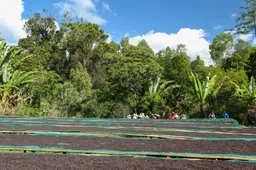 Tadese Tako - Worka YirgacheffeSemi-Pro Coffee$9.40 /100gEthiopiaChocolateCaramel & sweet
 Blendo 54core roasters$10.00 /100gBoliviaChocolateCaramel & sweet
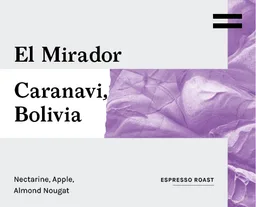 El MiradorCraftwork Roasting Company$10.00 /100gBoliviaCaramel & sweetStone fruit
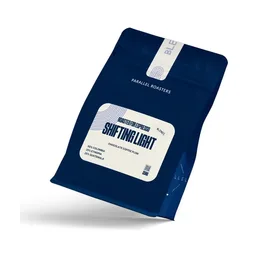 Shifting LightParallel Roasters$10.00 /100gEthiopiaChocolateCaramel & sweet
 Larecaja - Bird Friendly ProgramLittle Fish Coffee Roasters$5.80 /100gBoliviaChocolateCaramel & sweet
Find Central Coast Coffee beans near me
Central Coast Coffee
Beans sold here by the roaster
Central Coast
Beans sold here by the roaster