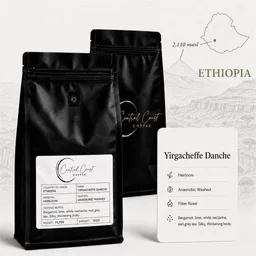
Yirgacheffe Nigist Girmachew
From Central Coast Coffee in Somersby, NSW
Tasting notes
Milk chocolate, Lemon rind and rose botanicals
- Origin
- Ethiopia · Yirgacheffe, WegidaProducer: Nigist Girmachew
- Roast
- Medium · For espresso
- Process
- Natural
- Caffeine
- Regular
- Varietals
- JARC Varieties
- Altitude
- 2200 masl
What Central Coast Coffee say
This coffee’s roasted in our espresso style — but that doesn’t mean you need to brew it as espresso. You can make it however you like — espresso, filter, moka pot, AeroPress or whatever you enjoy. We roast it a touch darker than we would a filter roast to caramelise the sugars and bring out smooth chocolatey and nutty flavours that cut beautifully through milk.
When you add milk the natural sweetness, fat and proteins tend to soften acidity and highlight caramelised flavours. That’s why lighter filter roasts can sometimes taste a bit sharp or sour with milk — they’re simply not built for it. Espresso roasts being more developed balance this out. The deeper caramelisation creates toffee and cocoa notes that blend harmoniously with milk’s creaminess while a hint of gentle bitterness adds that satisfying ‘coffee punch’ in your flat white or cappuccino.
If you prefer your coffee black this roast will still give you a full-bodied rich cup with plenty of depth and sweetness. For a lighter fruitier experience you might enjoy exploring our filter range instead.
JARC varieties are specific, numbered Ethiopian coffee cultivars (like 74110, 74112, 74148, 74165) developed by the Jimma Agricultural Research Centre (JARC) for high yield, pest resistance, and great cup quality, distinct from wild "heirloom" coffees, offering unique flavors like peach, apricot, citrus, and florals, crucial for Ethiopia's specialty coffee scene.
The natural process involves drying whole coffee cherries under the sun, allowing the beans to absorb flavors from the fruit as they dry. This results in a coffee with a heavy body, fruity sweetness, and complex flavors. It’s commonly practiced in Ethiopia and Brazil, where the climate is conducive to sun-drying.
This coffee is stored in standard warehousing palletised under ambient conditions. Usually these coffees are in GrainPro bags to keep out moisture and protect beans. Suited for high-volume blends and economical Single Origins, frequent rotation ensures freshness.
The ROEST P3000 is a compact powerhouse that redefines what’s possible in small-batch production roasting. With the ability to roast 1–3 kg batches in under 7 minutes and crank out over 25 kg per hour, it delivers serious output without demanding a full-time operator. Automation handles everything from preheating to cooldown, with between-batch protocols ensuring consistent conditions roast after roast. Its slim footprint and lightweight build make it perfect for roasteries where space is tight but precision and efficiency are non-negotiable.
What truly sets the P3000 apart is its unmatched control and data richness. It features more than 18 sensors—bean, exhaust, drum, humidity, pressure, and even a first-crack microphone—paired with PID-controlled airflow, drum speed, and temperature. A built-in bean camera offers live visual feedback, eliminating the need for a trier and paving the way for future AI enhancements. Whether you’re dialing in new coffees or replicating profiles at scale, the P3000 brings the lab-level accuracy of the ROEST sample roaster into full production—effortlessly and repeatably.
Ethiopia | Yirgacheffe Nigist Girmachew | JARC / Local Landraces Natural Grade 1 - When is peak flavour?
Nigist Girmachew inherited her farm from her late husband and has been managing it since 2022, all while also raising her 7 children. As with so many small farms across Ethiopia, she grows local heirloom landraces at a lofty 2,200 metres above sea level. Her three-hectare farm is nestled in the highlands of Ethiopia’s favoured Yirgacheffe region, where heirloom varieties thrive at these high elevations under false banana shade trees.
Nigist does not use chemical fertilisers or pesticides on her farm, making her production technically organic. However, as with many producers throughout the country, certification costs are too high to warrant an official Organic seal.
All of Nigist’s coffee is processed using the Natural method, largely due to the fact that she’s a single parent farmer with limited finances and time. She receives a higher price for her coffees selling to our woman-led partner exporter than selling to a local washing station.
Nigist uses entirely natural growing practices and cultivates her coffee beneath false banana trees that provide shade and contribute to soil health. Her farm is composed primarily of vertisols (clayey soils that have deep, wide cracks for some time during the year) and luvisols (a fertile soil type, usually with a layer of rich humus overlaid on clay enriched subsoil). These soils are typical of this part of Ethiopia and are good for growing high quality Arabica at higher elevations, as they allow for deep rooting and a good nutrient reserve.
Alongside coffee, Nigist also grows crops such as avocado, potatoes, collard greens and enset (a member of the banana family and a staple food crop in Ethiopia), which provide both subsistence and income diversification.
Nigist is a member of the Ama Commitment Income Diversification Scheme, a project designed to allow partners to get involved with meaningful on-the-ground change for women in rural Ethiopia. By working directly with farmers, the initiative allows women to earn significantly better prices than they previously received. Nigist receives a 30% upfront payment for her coffee and the remaining balance is paid upon arrival at the Addis Ababa warehouse. The pricing model offers her a better rate than the local market, strengthening financial stability and rewarding quality.
Ripe cherries are handpicked at peak maturity and floated to remove quakers before drying. The cherries are dried on raised beds for 12 to 15 days, depending on weather conditions, with regular turning to ensure even drying. Once dried, the coffee is transported to Moplaco in Gerji, Addis Ababa, where it is stored before moving by train to Djibouti for export.
Similar beans
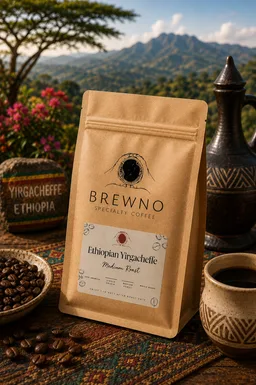 Halo Berti Yirgacheffe · MediumBrewno Specialty Coffee$10.00 /100gEthiopiaChocolateCitrus
 CarouselReverence Coffee$6.80 /100gEthiopiaChocolateCitrus
 Gordon Street BlendMoon Boy Roast House$8.00 /100gEthiopiaChocolateCitrus
 Synergy Espresso BlendVillino Coffee Roasters$8.00 /100gEthiopiaChocolateCitrus
 The O.G · Click and CollectGabriel Coffee$5.50 /100gEthiopiaChocolateCitrus
Find Central Coast Coffee beans near me
Central Coast Coffee
Beans sold here by the roaster
Central Coast
Beans sold here by the roaster